

In the mining and construction aggregate industry, the jaw crusher is the undisputed workhorse for primary size reduction. But at the heart of this massive machine are the Jaw Plates—the critical, wear-resistant components that take the actual beating. If you want to keep your plant running smoothly and profitably, understanding your jaw plates isn't optional; it's essential.
A jaw crusher uses a fixed and a movable jaw plate to compress, fracture, and crush massive boulders and blasted rock. Think of jaw plates as the armor of your crusher. They serve two vital purposes:
They provide the aggressive surface area needed to compress and shatter hard materials efficiently and rapidly.
They act as sacrificial liners, absorbing extreme abrasion and impact to protect the expensive main frame of the crusher from catastrophic damage.
You wouldn't use a sledgehammer for a finishing nail, and you shouldn't use a standard jaw plate for every type of rock. The tooth profile dictates the final product shape and the lifespan of the plate:
Perfect for gravel and non-abrasive rock. Offers great grip and ideal tooth spacing for removing fines, giving a less slabby product. Wears fast in abrasive applications.
The go-to for abrasive or blasted rock. Features a flatter tooth profile taking serious beatings. Produces slightly slabbier products but lasts significantly longer.
A great all-rounder. Increased tooth contact surface area balances power requirements while delivering excellent wear resistance and a well-shaped product.
Built for the most challenging or slippery rock. Features a 40mm thicker fixed jaw die for maximum longevity (requires careful attention to fines removal).
If your feed material is prone to creating slabs, this uneven tooth height design specifically breaks them down, drastically improving product shape.
A versatile profile designed to improve material flow, boost production rates, and offer a solid wear life across various standard applications.
The shape of the plate is only half the battle; the metallurgy is what keeps it in the machine.
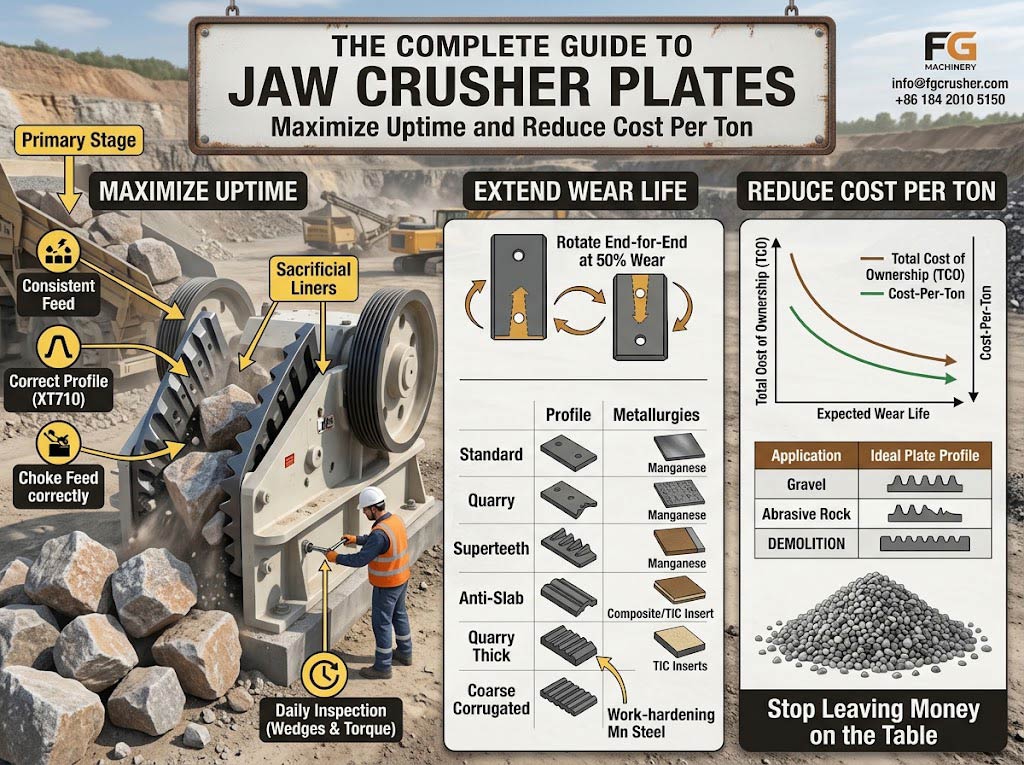
The industry standard. Manganese has a unique ability to "work-harden"—the more it gets pounded by rock, the harder its surface becomes, while the core remains tough.
These specialized alloys offer superior defense against extreme, sliding abrasion, though they can be more brittle than traditional high-manganese.
The heavy artillery. These plates feature embedded Titanium Carbide (TIC) inserts inside a manganese matrix, offering maximum wear resistance for the most abrasive tasks.
If you are burning through plates, one of these culprits is likely to blame:
Stop leaving money on the table. Extend your service life and optimize your cost-per-ton with these daily practices:
Crusher parts are not just maintenance items; they are the biggest lever you have to control your profitability. At Future Green Machinery, we don't just sell metal. We engineer solutions with precision fit, advanced metallurgy, and expert guidance.
Emergency:
+8618420105150Copyright © 2026 Guangzhou Future Green Machinery Co., Ltd. All Right Reserved.
 Network SupportedXML Privacy Policy


 English
  English
 Español
 Português